
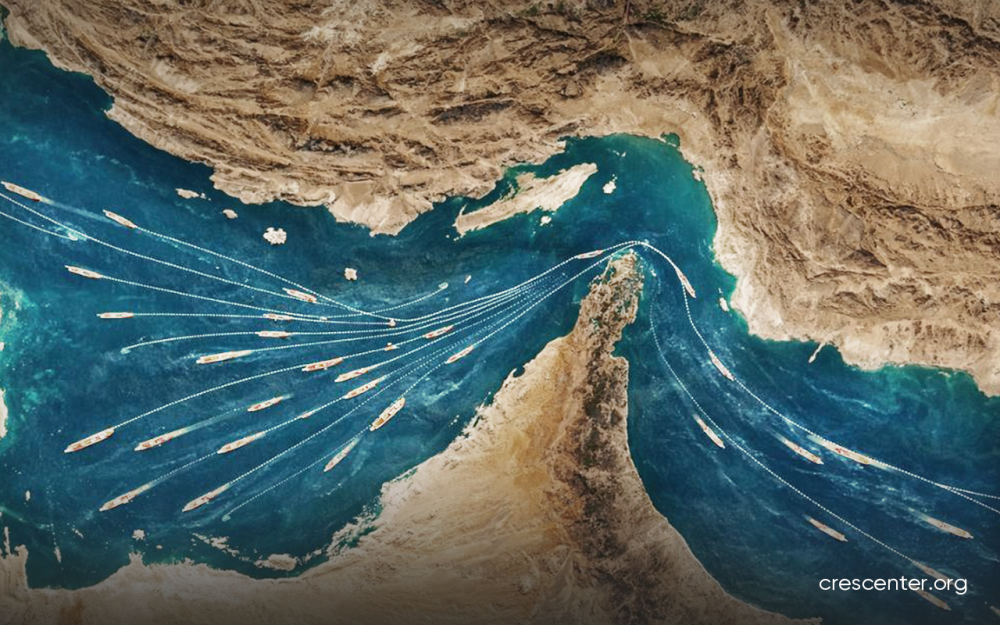
The ongoing military confrontation in and around the Persian Gulf and Gulf of Oman has produced a serious and expanding environmental crisis. Several oil-pollution incidents have been reported in waters affected by the conflict, including oil slicks near Qeshm and Sirri Islands following damage to vessels, as well as the massive spill from the Caroline Bezengi, a tanker that sustained an explosion while navigating the conflict-affected waters and subsequently ran aground off Oman. The latter incident has resulted in a rapidly expanding oil slick that has reached the Omani coastline and threatens ecologically sensitive marine areas.
Taken together, these incidents demonstrate how military confrontation and attacks affecting commercial shipping can translate into significant marine pollution, extending the environmental consequences of warfare beyond the immediate battlefield. However, the emergence of oil pollution in the Persian Gulf in the context of military confrontation is not without historical precedent. The environmental consequences of armed conflict in oil-producing maritime regions have repeatedly demonstrated that military operations can generate large-scale marine pollution, particularly when oil terminals, tankers, pipelines, offshore facilities, or energy infrastructure become targets of military action.
The most significant precedent for conflict-related oil pollution in the Persian Gulf occurred during the 1990–1991 Gulf War. In January 1991, Iraqi forces destroyed oil terminals, tankers and oil facilities in Kuwait, releasing an estimated 6–8 million barrels of crude oil into the Persian Gulf. The spill formed a massive oil slick and contaminated approximately 400 miles of Saudi Arabia’s western coastline, making it one of the largest marine oil spills associated with armed conflict. A comparable incident occurred during the 2006 Lebanon War, when Israeli strikes on the Jiyeh power plant south of Beirut damaged fuel-storage tanks and released an estimated 10,000–15,000 tons of heavy fuel oil into the Mediterranean Sea. The contamination affected approximately 150 kilometers of Lebanese coastline and extended to parts of the Syrian coast, illustrating how attacks on energy infrastructure during armed conflict can generate significant transboundary marine pollution.
Regardless of questions concerning attribution, responsibility or the identity of the parties responsible for these incidents, the environmental consequences of conflict-related oil pollution extend well beyond the immediate parties to the hostilities. Marine pollution does not respect political or territorial boundaries; once oil enters a semi-enclosed and highly interconnected marine environment, its effects can spread across coastal areas and affect entire ecosystems in different dimensions. In this sense, the environmental consequences of armed conflict are not merely ecological or humanitarian concerns; they can also cause significant implications for international economy, peace and security.
The security implications of such environmental damage may be more profound than its immediate ecological costs. In a strategically sensitive region such as the Persian Gulf, where environmental damage persists beyond the cessation of hostilities, the resulting loss of livelihoods, competition over resources, displacement and demands for compensation and remediation may become sources of political tension among affected states. The United Nations Environment Program has emphasized that environmental degradation can undermine post-conflict recovery and lasting peace, while damage to natural resources can contribute to insecurity and prolong instability. In this sense, conflict-related oil pollution should be understood not simply as collateral environmental damage, but as a potential long-term multiplier of regional insecurity, with consequences that may continue after the military confrontation itself has ended.
At the international level, the economic dimension makes these consequences even broader. The Persian Gulf is integral to global energy and maritime trade and prolonged insecurity in its waters can generate higher shipping and insurance costs, disrupt energy flows and increase price volatility well beyond the region. The current disruption around the Strait of Hormuz already demonstrates this transmission mechanism: oil flows through the strait have fallen sharply, while freight rates and energy-market uncertainty have increased. Consequently, the financial burden associated with conflict-related environmental damage may extend beyond the costs of cleaning contaminated waters or restoring ecosystems to include insurance premiums, compensation claims, lost revenues, disrupted trade, increased energy costs and the public expenditure required for long-term environmental remediation. The environmental consequences of conflict can therefore become an economic externality of war, transferring part of the financial burden of a regional military confrontation to states, markets and populations far beyond the immediate theatre of conflict.
Preventing the further deterioration of the situation requires a broader understanding of the consequences of military operations at sea. States engaged in armed conflict should not assess naval operations solely through the lens of deterrence, military advantage, or immediate strategic objectives; they should also anticipate the foreseeable environmental consequences of attacks on vessels, ports, oil infrastructure and other maritime facilities. This is not merely a matter of environmental policy, but also a requirement increasingly reflected in international humanitarian law. The principles of proportionality and precaution require parties to take feasible measures to avoid or minimize incidental damage to the natural environment, while the protection of the marine environment is reinforced by the broader obligations of international environmental and law of the sea regimes.
More fundamentally, maritime warfare should be approached as an issue of environmental security and international peace and security, rather than solely as a military domain. An attack that produces extensive and persistent marine pollution may generate consequences long after the military objective has been achieved: degradation of fisheries and coastal livelihoods, disruption of maritime commerce, pressure on water and food security, and disputes over responsibility, compensation and environmental restoration can create new sources of tension among states and communities. The protection of the marine environment should therefore form part of conflict prevention and peacebuilding strategies, not merely post-conflict remediation.
Recognizing this dimension would encourage states to incorporate environmental risk assessments into military planning and targeting decisions, establish mechanisms for rapid notification and cooperation following maritime pollution incidents, and treat the preservation of shared marine ecosystems as an element of regional stability. Such an approach reflects the broader recognition that environmental degradation can undermine peace and that protecting natural resources during conflict is itself a component of sustainable peace.
Sara Famoori